


Benefits of Reformer Pilates for Strength, Posture and Flexibility
The benefits of Reformer Pilates show up in practical ways. It can help build strength, improve posture, increase flexibility and develop better balance and movement control. Because the machine uses adjustable spring resistance, exercises can also be adapted for different fitness levels.
So, is Reformer Pilates good for you? For many people looking for a controlled, low-impact way to work on strength, posture and mobility, it can be a useful addition to a regular fitness routine.
If you're completely new to the equipment, our guide to what Reformer Pilates is explains how the carriage, springs and straps work.
What actually makes a reformer different from a mat?
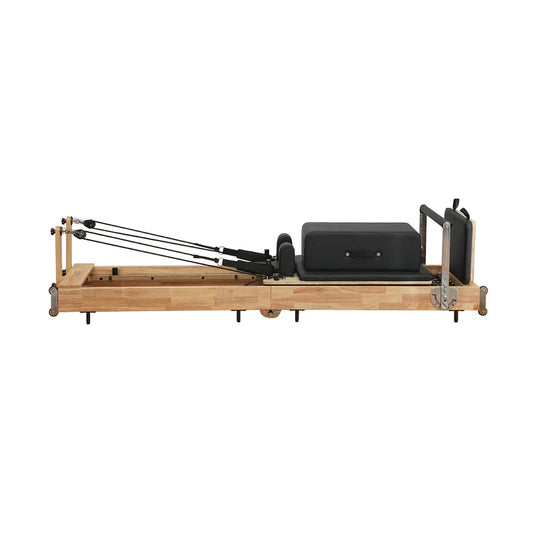
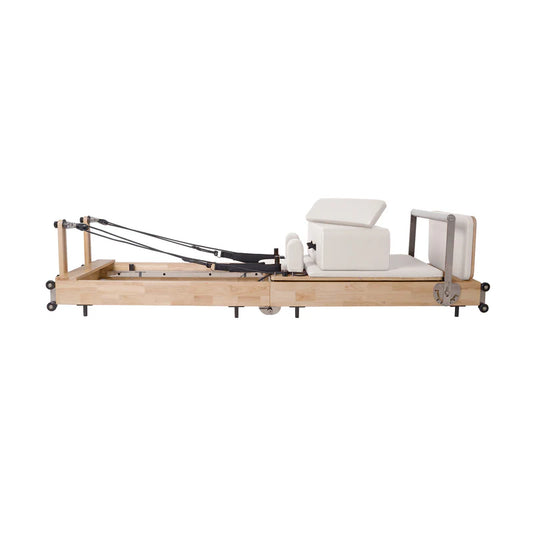
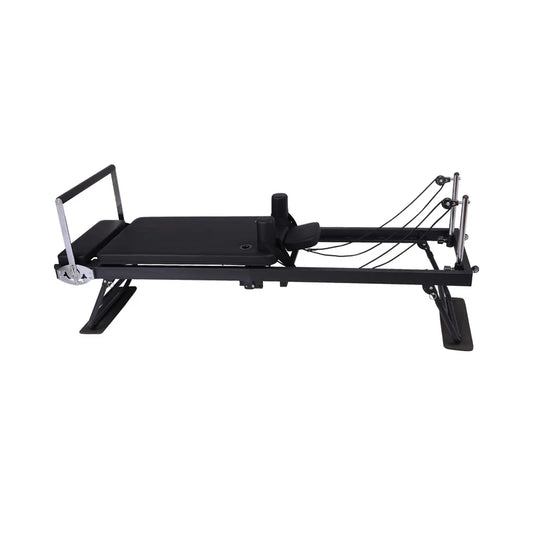
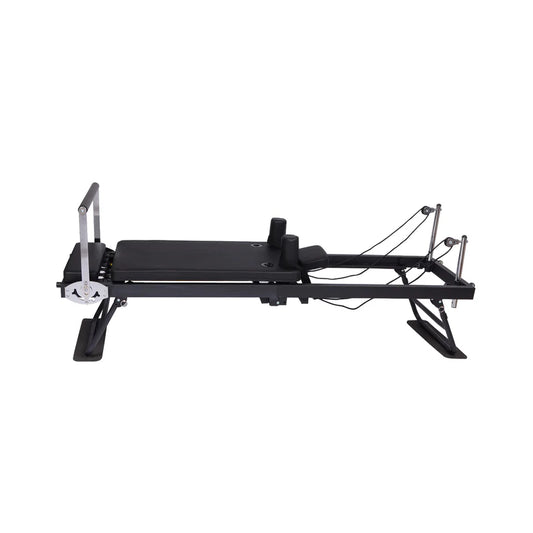
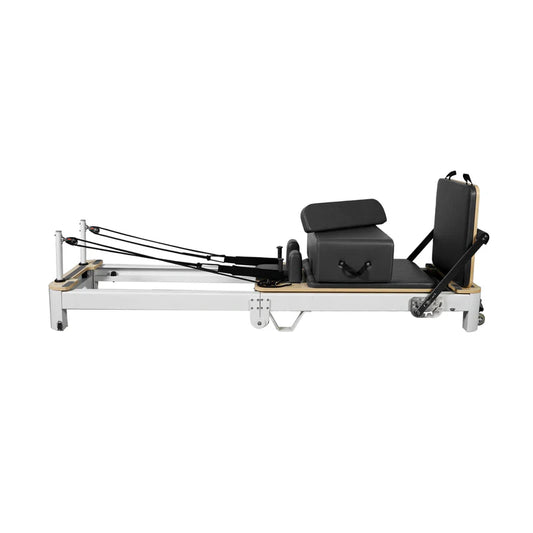
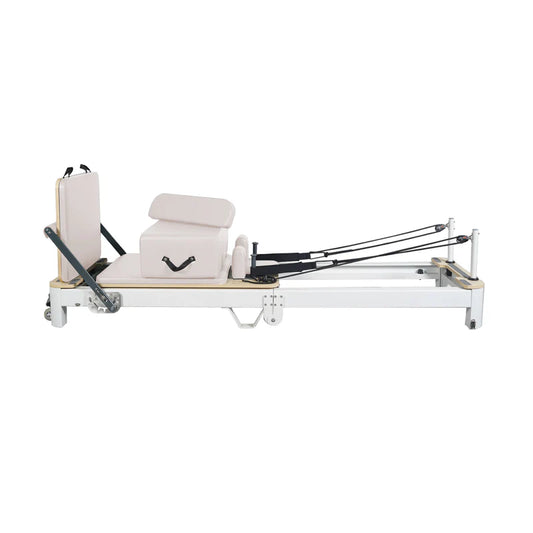
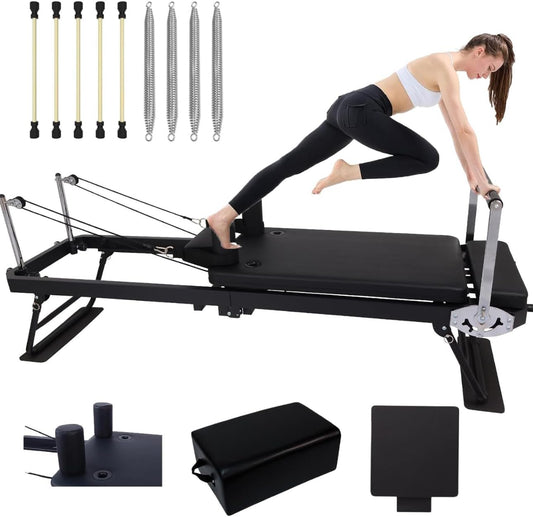
A mat workout relies entirely on body weight. A reformer adds a sliding carriage, a set of adjustable springs, and a system of straps and a footbar that adjust what your limbs do while your core stays locked in. This kind of pilates reformer equipment resists you in both directions, out and in, so your muscles stay switched on the whole time instead of coasting through the easy half of a movement. That's part of why people talk about Pilates reformer benefits as distinct from just "Pilates"; the spring resistance generally changes the whole feel of an exercise you might already know from a mat class. You can start on the lightest spring in the room and still get something out of the session. Resistance goes up gradually, once your body's actually ready, not before.
- Sale price
- £589.99
- Regular price
-
£989.99 - Regular price
- £589.99
- Unit price
- per
- Sale price
- £525.00
- Regular price
-
- Regular price
- £525.00
- Unit price
- per
Building strength that holds up outside the studio
Here's the thing about strength built this way: it doesn't look like gym strength, and honestly, it doesn't need to. The carriage forces your core to stabilise constantly while your arms or legs do the resisted part of the movement. Bending, lifting, twisting, and reaching, the same stuff you do when carrying shopping up a flight of stairs, or picking a toddler up off the floor, gets trained directly.
Free weights occasionally let momentum sneak in. A sloppy barbell row still moves the weight, after all. On a reformer, there's nowhere to hide; the spring tension stays constant, so the muscle works the whole range instead of just the easy bit. This is roughly what people mean when they bring up Pilates machine benefits in general it isn't flashy, but it's honest training.
A typical reformer Pilates workout might run:
- Footwork on the carriage to build leg and glute strength
- Leg presses for control through the full range of motion
- Strap-based arm work with the spine braced against the carriage
- Core sequences that target the deep stabilising muscles most gym routines skip entirely
I'd argue this is where the reformer earns its reputation, if I'm honest. It's not really about visible muscle. It's about the kind of strength that holds your spine together when you're tired, distracted, or moving badly, which is most of an average day if we're being truthful about it.
Posture: a slower, quieter kind of progress
Posture doesn't improve because you decide to sit up straighter. The reformer works to develop the postural muscles more than anything else; slouching is typically a sign of weak postural muscles. Almost all exercises require core engagement during the movement to control the carriage, which means that the deep back and abdominal muscles that keep the spine up are activated during the exercise as well, even when they aren't directly targeted. That adjustability is exactly why reformer Pilates for beginners doesn't feel as intimidating once you actually get on one.
The footbar and straps also gently push into your shoulders and pelvis to position them in a more aligned state, as well, which helps fix some of the imbalances that develop over the years when you're at a desk.
Don't expect a miracle after one class, though. Two or three sessions a week, kept up for a month, tend to change how your shoulders sit and how your lower back feels by the end of a long day.
Flexibility, without forcing anything
Flexibility usually gets bolted onto the end of a workout if there's time left over. A reformer folds it into the main session instead. The springs assist your stretches, letting you move into ranges of motion that would be harder or riskier to control on your own. Hamstrings, hip flexors, shoulders- all the usual tight spots from sitting too much- respond well to this.
Because the resistance is adjustable, stretches get supported rather than forced, which is low-impact Pilates workout territory in its purest form. Your joints aren't taking the pounding they would in a deep, unassisted static stretch, but the muscle still lengthens properly.
Going beyond the standard carriage
Some studios and a handful of ambitious home setups incorporate Cadillac Reformer Pilates equipment, adding a Pilates trapeze table alongside the standard Reformer machine. It opens up suspended and assisted movements the carriage alone can't do, which is particularly useful for rehab work or advanced mobility training. Most people don't need one at home. Still, it's worth knowing it exists, especially if you're the type who'll outgrow the basics fairly quickly.
Is reformer Pilates actually good for weight loss?
People ask this constantly, and whether reformer Pilates is good for weight loss claims holds up depends a bit on what you're comparing it against. You'll burn fewer calories per hour than, say, a spin class. But you build lean muscle efficiently, and muscle raises your resting metabolic rate over time. For anyone running a studio or a small clinic, commercial reformer Pilates machines are built on a completely different standard: heavier frames, tougher springs, parts designed to survive a dozen different bodies using them every single day. Combine that with how joint-friendly the whole thing is, and you get something a lot of people can actually keep up with for years, which matters more for results than any single session's calorie burn ever will.
Bringing a reformer into your own home
The shift toward home workouts that started a few years ago never really reversed. People got used to training on their own schedule, and a lot of them never went back to booking studio slots around someone else's timetable. That's driven by real demand for a home Pilates reformer machine UK buyers can actually rely on daily, without the build quality dropping off compared to a studio.

Space tends to decide the matter for most home buyers, which is exactly why Pilates reformer folding designs have taken off: a frame that folds flat against a wall, or slides under a bed, making the whole idea realistic for a flat, not just a house with a spare room going spare. Picking between home and commercial really just comes down to how much use the machine is going to get.
Who tends to benefit the most?
- Runners and cyclists usually carry tight hip flexors and underdeveloped stabilisers around the pelvis, which the reformer goes after directly
- Office workers — rounded shoulders and a stiff lower back respond well to the postural side of the training
- Older adults — the joints stay protected while real strength still gets built; dial the springs down, and the session still works
- Pregnant and postnatal clients — once cleared by a doctor, the stability of the carriage helps, since movements adapt easily to different stages
It's worth saying, since the assumption still floats around, that this isn't just a workout "for women" or "for people who are already fit." Rugby players, footballers, and military personnel use reformer training as part of serious conditioning programmes, precisely because the strength gains don't beat up the joints along the way.
What does the first month tend to look like?
The first sessions are primarily to learn how to make the machine do what the springs are doing, how to brace against the carriage and how to maintain alignment honesty with a movement. This is the most important stage and not the most obvious one, since if the bad habits are not corrected during the first week, then they tend to live on.
In week two or three, most people realise that they are not as tired from running with the carriage and that they aren't struggling as much. By the end of the month, posture starts improving outside of class too, standing taller without thinking about it, sitting better, moving with a bit more control through ordinary tasks. None of it's dramatic. It just adds up.
FAQs
Is Reformer Pilates good for strength training?
Is Reformer Pilates good for strength training?
Yes. Reformer Pilates uses adjustable spring resistance to challenge muscles throughout controlled movements, helping develop strength, stability and muscular endurance across the whole body.
What are the main Reformer Pilates benefits?
What are the main Reformer Pilates benefits?
The main Reformer Pilates benefits include improved strength, core stability, posture, flexibility, balance, mobility and body awareness through controlled, resistance-based movements.
What is a Pilates reformer good for?
What is a Pilates reformer good for?
A Pilates reformer is useful for strength training, flexibility, mobility, posture, balance and controlled full-body exercise using adjustable spring resistance.
Does Pilates Reformer build muscle?
Does Pilates Reformer build muscle?
Reformer Pilates can strengthen and condition muscles using resistance. It is particularly effective for the core, glutes, legs, back, shoulders and stabilising muscles.
Is Reformer Pilates strength training?
Is Reformer Pilates strength training?
Yes. Reformer Pilates qualifies as resistance-based strength training because your muscles work against adjustable spring tension while controlling the carriage and your body position.
Is Pilates Reformer resistance training?
Is Pilates Reformer resistance training?
Yes. Springs provide resistance during exercises, and the resistance level can be adjusted depending on the movement, training goal and user's ability.
Does Reformer Pilates help with posture?
Does Reformer Pilates help with posture?
It can support better posture by strengthening the core, back, hips and shoulders while improving body awareness and control during movement.
Is Pilates Reformer good for flexibility?
Is Pilates Reformer good for flexibility?
Yes. Reformer exercises can combine controlled stretching with spring assistance, helping improve flexibility and mobility without relying entirely on unsupported static stretches.
What are the Reformer Pilates benefits for women?
What are the Reformer Pilates benefits for women?
Women may use Reformer Pilates to develop strength, posture, flexibility, core stability and balance through adjustable, relatively low-impact resistance training.
Is Reformer Pilates good for you?
Is Reformer Pilates good for you?
For many people, Reformer Pilates can be a useful form of controlled exercise for strength, mobility, posture and flexibility. Individual suitability depends on health and fitness needs.

Recent Posts


- Sale price
- £589.99
- Regular price
-
£989.99 - Regular price
- £589.99
- Unit price
- per
- Sale price
- £699.00
- Regular price
-
- Regular price
- £699.00
- Unit price
- per
- Sale price
- £525.00
- Regular price
-
- Regular price
- £525.00
- Unit price
- per


